
The New ROI: Return on Involvement
May 15, 2026
by Monette Anderson, CAE

As of 2024, investors have poured nearly $1.6 trillion into artificial intelligence (AI)1. Global capital expenditures are projected to approach $700 billion by 2026. The investment is massive, but the success rate is sobering: nearly 95% of generative AI corporate pilots fail to deliver measurable ROI, according to a 2025 MIT report2.
The disconnect isn't technical. It is a failure of the human systems required to integrate these tools. While technology is remarkable at scaling efficiency, it also scales whatever culture already exists.
Think of AI as a mirror. If your organization’s culture is siloed and burnt out, AI will only automate the silos and accelerate the burnout.
- AI boosts performance only in highly collaborative teams, according to Microsoft Work Trend Index 20253.
- As automation increases, uniquely human capabilities, such as collaboration, adaptability, and judgment, become more valuable, not less, explains Deloitte’s “State of AI in the Enterprise: The untapped edge” report4.
- Firms with engaged employees and strong cultures dramatically outperform those that treat AI as a purely technical upgrade, found McKinsey in its 2025 Global Survey on the state of AI5.
The data points to a clear conclusion: the limiting factor in AI adoption is not the technology. It is the human system around it. Authors in the Harvard Business Review6 have repeatedly emphasized that “weak [social] ties” (the broader network of professional acquaintances beyond one’s immediate circle) are what drive innovation. AI doesn't replace the need for these ties; it increases the importance of the trust and culture that a robust network provides.
Why Return on Involvement is your Competitive Advantage
During WSCPA firm visits across the state this year, we heard a recurring tension that stems from the talent scarcity in our profession: many organizations remain cautious about encouraging their staff to increase their external visibility. We heard broad concern that exposing top talent to the broader profession creates a poaching risk. However, other firms take a different view with one firm saying, “If our staff leave for a competitor from attending an industry event, shame on us.” Another firm leader recently shared that he often tells his staff, “CPA stands for Certified Public Accountant. If we’re not in the public, we’re missing the point.”
When professionals engage beyond the four walls of their own firm, the organization gains an operating advantage through:
- Perspective under pressure: Exposure to how peers are navigating AI, succession, and regulatory change in real-time.
- Leadership maturity: Structured environments where professionals test ideas, compare strategy, and develop decision-making capacity.
- Professional Ecosystem Literacy: Understanding the legislative intent of a new regulation while it is still in committee rather than reacting after it has passed.
- From “Job” to “Profession”: Professional embeddedness can be a primary driver of staff retention. When work ceases to be a series of tasks and becomes a career, it creates a shift in identity that acts as a powerful deterrent to burnout.
From Engagement to Design
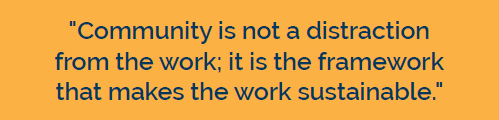
What if in response to this, the most groundbreaking strategy is to design external exposure intentionally? This means moving beyond seeing professional community as a "calendar activity" and instead treating it as a core business function. In practice, this design can take many forms:
- Dedicated professional development stipends earmarked specifically for staff to engage within the profession
- Structured participation in peer cohorts and cross-firm roundtables to stress-test internal strategies
- Encouraging staff to serve on committees and advisory groups that shape the professional standards staff must eventually follow
- Creating space for staff to speak, publish, and contribute publicly, elevating the firm’s brand through the expertise of its people
The WSCPA does more than host events; we build the type of community that supports this engagement. We serve as the laboratory where your team can develop the professional grounding and ecosystem literacy that your internal systems may not provide alone.
Whether it is through our Committees and Resource Groups for real-time peer troubleshooting and building learning engagement at conferences, our Advocacy teams protecting the profession's interests, or our Emerging Leader Committee designed to connect professionals regionally through networking and service projects, we are here to help you scale your human systems alongside your technology.
How is your firm designing exposure this year? Need help plugging in on an individual or firm-wide scale? Reach out to me or fill out a committee interest form to be plugged in.

Monette Anderson, CAE, is WSCPA Vice President of Membership and Education and Executive Director of the Washington CPA Foundation. Contact Monette by email.
photos: : ©iStock/miniseries, ©Shelly Oberman Photography
Sources:
- Elias, Jennifer, “Tech AI spending may approach $700 billion this year, but the blow to cash raises red flags”, CNBC.
- The GenAI Divide: State of AI in Business 2025. MIT.
- Microsoft Work Trend Index 2025.
- The State of AI in the Enterprise: Deloitte’s 2026 AI report tracking adoption and impact.
- The State of AI in 2025: Agents, innovation and transformation: McKinsey
- Bojinov, Iavor, et al. “Which Connections Really Help You Find a Job.” Harvard Business Review, 1 Dec. 2022.