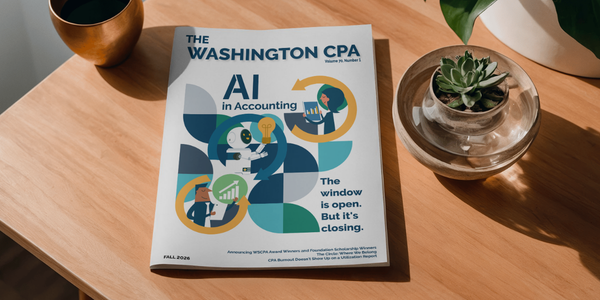
AI in Accounting: The Window is Open, But it's Closing
November 02, 2026
by Karishma Menon, MSAcc; Anoop Mehta, CPA, CGMA; and Dr. Arindam Tripathy
AI is on its way to becoming as ordinary as spreadsheet software. The work it can’t do happens to be the most valuable work in the accounting profession, and the next two years are your best opportunity to position yourself to do more of it.
Walk into any accounting conference these days and you’ll hear the same story on repeat. Organizations are rushing to implement AI, and partners are excited. According to Karbon’s 2025 "State of AI in Accounting" report, 63% of owners, directors, and partners are enthusiastic about adoption, and practitioners using AI save an average of 56 minutes a day.
But most organizations are fighting yesterday’s war. Whether to adopt AI is a settled question, with QuickBooks, Xero, Thomson Reuters, and CCH all racing to make it standard issue. The question that actually matters is what happens when everyone has it, when AI becomes ubiquitous.
In 2003, Nicholas Carr published "IT Doesn’t Matter" in Harvard Business Review. His thesis was simple: when everyone has access to the same technology, the technology itself stops being a competitive advantage. It becomes table stakes, necessary for survival but not sufficient for winning. He extended the argument in The Big Switch (2008), tracing how computing went from private data centers to a utility you rent by the hour. This pattern is unfolding with AI in accounting now.
Technology doesn’t transform industries overnight. It moves in waves, and knowing which wave you are in is what lets you position for the next one. In "When AI Stops Being Special" (2026), Menon et al. draw on interviews across audit, tax, advisory, and bookkeeping, at organizations from boutique shops to mid-sized regional players, to set out three waves of AI in accounting.
The Three Waves
Wave One: Early Advantage. This is where things stand today. One 15-person firm cut bookkeeping hours by about 35% after implementing AI document extraction, going from three full-time bookkeepers to two and picking up eight new clients without hiring. Clients notice when you deliver work in two days instead of five, and they’ll pay for it. One partner raised monthly retainers by 20% after automating, and clients thanked them because the turnaround was so much quicker.
This advantage has an expiration date.
Wave Two: Rapid Democratization. Mid-sized firms are getting their hands on tools that were exclusive to big firms 18 months ago, and 66% of firms with 21 to 50 staff are already excited about AI and moving fast. Cost barriers are collapsing: capabilities that used to require six-figure consulting engagements are now $49-a-month subscription add-ons. When everyone has the same efficiency gains, that becomes the new baseline, and the premium you could charge for AI-enhanced service disappears with it.
Wave Three: Infrastructure Reality, 12 to 24 Months Out. AI stops being a feature and becomes how accounting software works, like spell-check in Word. Clients and organizations will expect it, then probably stop caring about it, the same way nobody asks whether your firm uses Excel. The questions shift: What unique insights do you provide? What judgment do you bring that the AI can’t?
Where is the Divide?
AI is very good at exactly the kind of work that’s easiest to commoditize. Bookkeeping and client accounting services are ground zero, where practitioners estimated that automated ingestion, categorization, and reconciliation can cut manual effort by 60 to 70%; one firm went from eight hours per client per month to three, at the same quality. Data extraction, form population, and basic research in tax preparation are going the same way, so a value proposition built on filling out forms accurately is fragile, and in external audit, tests of controls and substantive testing are increasingly AI-driven already.
Now look at what typically isn’t getting automated:
- Tax planning and strategy
- Financial advisory and business consulting
- Audit judgment and risk assessment
- M&A advisory
- Forensic accounting
- Complex technical accounting consultation
- CFO advisory services
- Ethical and fiduciary responsibility
Everything on the first list follows rules. Everything on the second requires judgment. Menon et al. (2026) report that 72% of professionals already agree AI will shift their roles from compliance to advisory.
The problem is that most organizations are automating compliance work without a plan for what comes next. One partner in the study put it this way: "We automated our monthly close process. Saved about 15 hours per client per month. Great, right? Except now we don’t know what to do with those 15 hours. Do we take on more clients? Do we try to upsell advisory? Do we cut staff? We just... haven’t figured that part out yet."
The real challenge isn’t the technology. It’s the strategy.
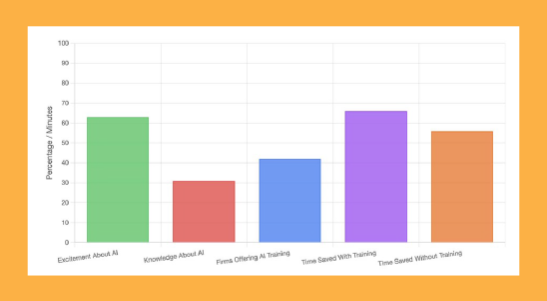
Figure: High excitement about AI coexists with low knowledge; yet firms providing training see 18% better results. Source: Data from Karbon’s 2025 "State of AI in Accounting" report.
Capability, Not Tools
Karbon’s 2025 report finds high excitement about AI, especially at the leadership level, yet 69% of professionals describe themselves as "not knowledgeable" about it, and most organizations underinvest in training despite clear evidence that it pays: firms offering AI training see 66 minutes a day in time savings, against 56 for those without.
The tools alone don’t deliver this. For example, Menon et al. find a 35-person firm that spent $18,000 on a document processing system that tested at 94% accuracy and dropped to 71% on live client data, and a partner who described a team split between those who think AI will take their jobs and those who think it will make more work, with neither group wanting to learn it.
The same logic favors starting narrow and deep: one high-volume, low-judgment workflow, proven and measured, before anything expands. One organization in the study that audited its own hours found 67% going to data entry and rules-based compliance. But freed-up capacity only becomes advisory revenue if the people have somewhere to grow into, which brings this back to the individual.
Positioning Yourself While the Window is Open
The advice to accounting professionals runs in a particular order. Get fluent with the tools first, because that has the shortest learning curve, then spend the capacity it frees on the capabilities the tools can’t give you.
Get comfortable with AI, but don’t make it your whole thing. Fluency is not expertise. You don’t need to understand transformer architectures. You do need to know what AI can and can’t do reliably, recognize when output needs verification (hint: always), and understand which tasks to delegate and which need human judgment. Skepticism about accuracy and data privacy shrinks with understanding rather than reassurance, which is why the people most wary of these tools are usually the ones who have used them least. Think about Excel in the 1990s: the winners weren’t the macro experts, whose skills got commoditized fast, but the people who used Excel as a tool while focusing on financial analysis.
Use the time it gives back. The payoff is in per-person terms: 56 minutes a day is roughly 18 hours a month, about a tenth of an FTE, or on the order of $10,000 a year per professional against a $100,000 salary benchmark. That is capacity you can point at something. You also don’t need to wait for a firm-wide program to start, because adoption tends to run bottom-up, and the people who build the habit early become the ones their colleagues learn from.
Ask yourself the uncomfortable question. If AI can do 70% of what you currently do, what’s the 30% that makes you valuable? "I have good client relationships" isn’t specific enough. "I help manufacturing clients identify tax credits they didn’t know existed" is, and so is "I spot cash flow problems three months before they become crises." If you can’t name yours yet, that’s a good place to start building.
Go deep, not wide. Being a generalist is a losing position, because AI can do generalist work. Your value is in expertise AI can’t replicate from reading a textbook, so go back to the list of work that isn’t getting automated and pick from it. That might be an industry vertical such as construction, restaurant groups, or medical practices, understood deeply enough that you become the person other accounting professionals call for a solution. It might be a technical area such as cost segregation, R&D tax credits, or employee benefit plan audits, or strategic tax planning, which answers "How should we structure this?" rather than "What forms do we file?" Specialize where context and judgment beat processing speed. That takes 12 to 18 months of dedicated learning through courses, certifications, industry groups, writing, and speaking.
Master the human stuff. This is what most people overlook, and it’s probably the most important. The division of labor isn’t subtle: people excel at complex judgment, empathetic client interaction, and strategic thinking, and are limited by processing volume, repetitive accuracy, cognitive load, and hours in the day. AI is close to the inverse on every line, which is why the human column is where time compounds. Clients are drowning in data, and what they need is someone who can explain what it means. "Your margins dropped 3% this quarter because labor costs increased" is data. "You’re about to have a cash flow crisis in Q3 if we don’t make changes now" is insight. As a CFO advisory principal puts it, clients don’t need more reports; they need someone to tell them what the reports mean for their strategy. Accounting is anxiety-heavy work, and clients feel vulnerable in it, so reassurance and reading the unspoken dynamics in family business conflicts and succession planning matter as much as the technical answer. AI can flag an unusual transaction, but you must decide whether it’s an error, fraud, or something weird but legitimate. AI can cite professional standards. Humans have to live them.
Learn to sell advisory services. This is the most uncomfortable skill on the list and an essential one, because advisory work doesn’t sell itself. Clients don’t wake up thinking "I need strategic tax planning." They wake up thinking "I’m worried about cash flow" or "I’m thinking about selling the business." You need to be able to have those conversations: identify the problem, ask good questions, position the solution. If that makes you uncomfortable, take a sales course. Yes, really.
The Bottom Line
This isn’t only a story about work going away. The profession will need many more people doing advisory work, complex analysis, and the relationship-intensive, judgment-heavy work AI can’t touch. Look at what happened with the internet: fewer travel agents, but far more digital marketers, e-commerce specialists, and logistics coordinators. The work didn’t disappear, it shifted, and plenty of people will experience this shift as freedom from repetitive tasks.
That 12-to-24-month window sounds like a lot of time, and it goes quickly. Building advisory capability, developing a specialization, and repositioning a practice all take time, and the professionals who start now will be well positioned when AI becomes table stakes.
Carr was right in 2003, and his assertion applies to right now, too. When technology becomes universal, the technology itself stops mattering. What matters is the distinctive human value you bring: the judgment, the relationships, the expertise.
The window is open, and open is the useful part. The tools are cheap, the skills are learnable, and the work waiting on the other side is more interesting than the work it replaces. That will be less true in two years, when everyone has had the same chance at it. Pick one thing, make it specific, and give yourself a timeline.

Karishma Menon, MSAcc (UW Tacoma), specializes in AI-driven innovation across financial services. She leads operations at Decisionly, leveraging AI to transform card operations for major banks and fintechs. A London Business School alumna, she has experience in financial services and venture capital across India, the UK, Africa, and the US.

Anoop Mehta, CPA, CGMA, is the past chair of the American Institute of CPAs (2022-2023) and the Association of International Certified Professional Accountants. He is currently chair of the AICPA's National Commission on Diversity and Equity. He also serves as chief strategist at Analytical Mechanics Associates, Inc.

Dr. Arindam Tripathy is Professor of Accounting and an Accounting Excellence Fellow at UW Tacoma’s Milgard School of Business. He has published extensively in leading academic journals, and his research has been cited over 3,000 times.
References
- Carr, N. "IT Doesn’t Matter." Harvard Business Review, May 2003.
- Carr, N. The Big Switch: Rewiring the World, from Edison to Google. W.W. Norton & Company, 2008.
- Karbon. "The State of AI in Accounting." 2025.
- Menon, K., Mehta, A., & Tripathy, A. "When AI Stops Being Special: How Accounting Professionals Can Build Competitive Advantage as Artificial Intelligence Becomes Commonplace." 2026.
Note: This article is a summary based on "When AI Stops Being Special" (2026) by Karishma Menon, Anoop Mehta, and Dr. Arindam Tripathy. The full article is available at wscpa.org/cover.
Learn More
Attend the NEW! Client Advisory Services Summit on November 12 in Bellevue or webcast. Register here.
graphics: ©iStock/courtneyk, ©iStock/sorbetto, ©iStock/RLT_Images